
Activator Method chiropractor in Chesterfield, MO
Instrument-assisted adjusting with the handheld Activator: fast, measured, low-force corrections with no twisting and no cracking. A gentle option for patients who want one, or need one.
Some patients do well with a hands-on adjustment. Others tense up at the thought of being twisted or hearing a joint pop, and some have a spine that simply should not be adjusted that way. The Activator answers both. It is a small, spring-loaded handheld instrument that delivers a single, precise impulse into one joint at a controlled force. No rotation, no thrust from the doctor's body weight, no sound. Just a quick tap that gets a stuck segment moving again.
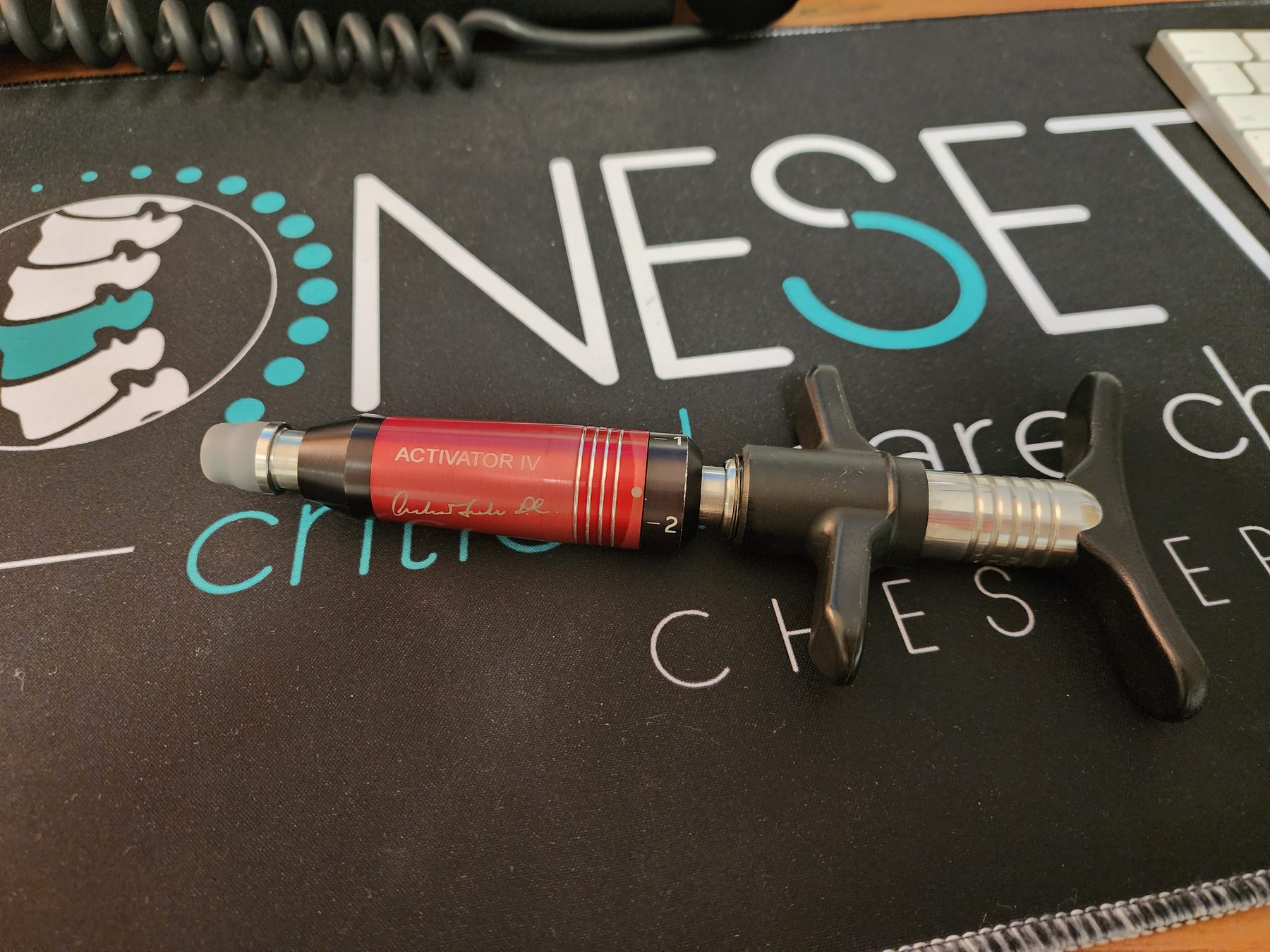
Why an instrument, and why so fast
The Activator works because it is quicker than your nervous system. When a hand pushes on a joint, your muscles sense it coming and tighten to protect it, which is part of why manual adjusting sometimes needs more force. The instrument fires its impulse faster than that guarding reflex can respond, so the joint receives the correction before the surrounding muscles brace against it. The result is a light, specific input that moves a single segment while leaving everything around it undisturbed. Because the force is measured and repeatable, Dr. Hayes can dial it down for a small child or a fragile spine and reproduce the exact same contact visit after visit.
Where it fits at Bonesetters
The Activator is one of several ways Dr. Hayes restores joint motion, and the technique is matched to the patient rather than the other way around. For patients who want instrument adjusting with a full read on how the spine is responding, our computer-guided adjusting pairs percussion adjusting with real-time analysis. The Activator sits at the gentlest end of that range: no screen, no cabling, just a focused hand-held correction he can apply the moment the examination points to a specific segment. He often uses it alongside hands-on work in the same visit, instrument where a light touch is called for and manual technique where it is not.
Who the Activator is for
It is the technique we reach for when force needs to be low and precision needs to be high. If the idea of a twisting adjustment has kept you out of a chiropractic office, or a past experience left you sore, this is a different experience entirely.
- Patients who are apprehensive about twisting, popping, or cracking
- Older patients and anyone with osteoporosis or fragile bone
- Acute, guarded neck pain that a forceful adjustment would only aggravate
- Infants and children, where a feather-light contact is all that is needed
- Spines where rotation is not appropriate, confirmed at the examination
Gentle does not mean guesswork. The Activator is low force, but the decision to use it is not casual. Your sixty minute examination determines which technique fits your spine, so the adjustment you get is the one your body actually needs.
What a visit looks like
Care starts with a thorough workup, not a table. At your first visit Dr. Hayes takes a full history, runs neurological, physical, and orthopedic testing, and identifies exactly which segments are moving poorly. For the adjustment itself you stay comfortably positioned, usually face down or seated, while he places the instrument on the specific contact point and delivers the impulse. Each correction takes a fraction of a second, and a series of them covers the segments that need attention. There is no soreness protocol to schedule around and no downtime, so you go straight back to your day. Because nothing here is rushed, he takes the time to show you what he found and why the Activator is the right tool for it.
Questions, answered
Does an Activator adjustment hurt?
No. The instrument delivers a quick, light tap into a single joint. There is no twisting and no popping, and most patients are surprised at how little they feel. It is one of the gentlest ways to adjust the spine.
Why use an instrument instead of adjusting by hand?
Speed and specificity. The Activator moves faster than your body can tense and guard, so it delivers a measured, repeatable impulse to one joint without the rotation a manual adjustment uses. That makes it a good fit when we want low force or a very precise contact.
Is the Activator as effective as a manual adjustment?
Both aim to restore normal joint motion, and the right choice depends on your body, your comfort, and what the examination shows. Dr. Hayes selects the technique that fits your case, and he often combines instrument work with hands-on adjusting in the same visit.
Is it safe for older patients or people with osteoporosis?
Its low force is exactly why the Activator is often chosen when a forceful rotational adjustment is not appropriate. Candidacy is settled at your examination, where Dr. Hayes screens for the conditions that would change the plan before anyone is adjusted.
Can children be adjusted with the Activator?
Yes. The gentle, low-force approach suits growing spines well. Pediatric visits are $35 for children under 14 when a parent or guardian is treated the same day.
Prefer a gentler adjustment? Let's talk.
One examination tells us which technique fits your spine. Book online or call the office and we will take a proper look.