
Pediatric chiropractic in Chesterfield, MO
Gentle, low-force care for infants, children, and teens, scaled to a small body. No twisting, no cracking, and $35 for kids under 14 when a parent is treated the same day.
Children are not scaled down adults, and they do not get hurt the way adults do. A toddler learning to walk falls dozens of times a day. A nine year old carries a backpack that is a quarter of their body weight on one shoulder. A high school athlete trains one sport year round on a skeleton that is still growing. Most of the time a young body absorbs all of that without complaint. Sometimes it does not, and what a parent notices is a child who holds their head tilted to one side, a kid who says their back hurts after practice, a teen whose shoulders are visibly uneven in a photo, or an infant who will only turn one direction in the crib.
Pediatric chiropractic here addresses those mechanical problems. Joints that are not moving well, muscles compensating around them, and posture that is setting into a pattern while the body is still forming. Nothing about it needs to be forceful to be effective, and on a small body it should not be.
Low force, every time
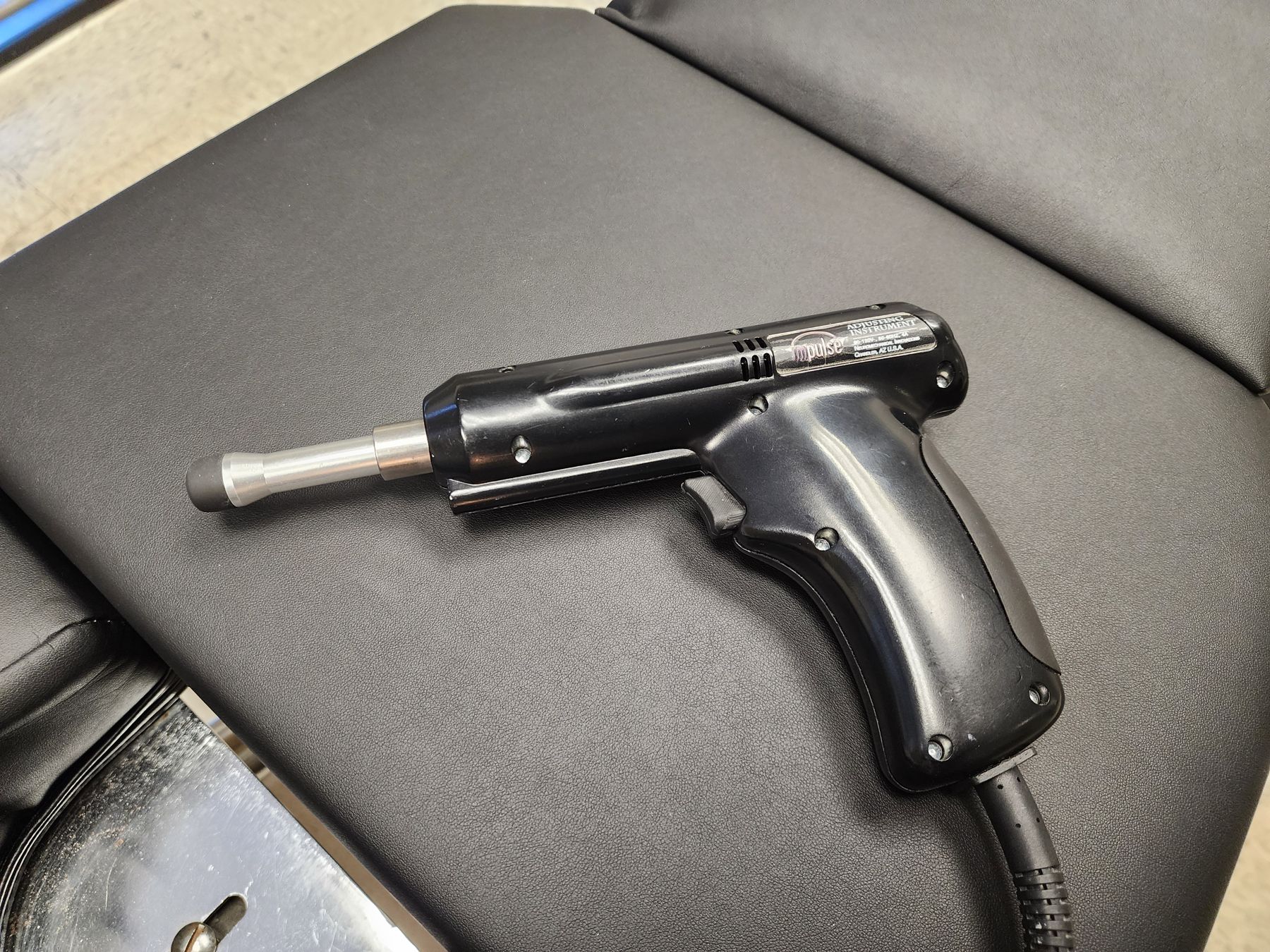
Adjusting a child is a different job than adjusting an adult, so we use different tools. Activator adjusting and the Impulse instrument deliver a fast, shallow, precisely aimed impulse that moves a specific joint without any twisting or stretching of the neck or back. The force is measured and repeatable, which matters most on the smallest patients. For infants and for children who are sore, guarded, or simply nervous, Dr. Hayes works even lighter: Logan Basic uses sustained, feather-light contact at the base of the spine to let the muscles release on their own, sacro occipital technique uses positioning and blocking rather than thrust, and cranial therapy addresses the fine mechanics of the skull and jaw with pressure most kids describe as someone resting their hands on their head.
What we address
- Infants who strongly prefer turning one direction, or who are stiff and uncomfortable through the neck
- Neck and back complaints in school-age children, including after a fall or a hard landing
- Posture that is settling in wrong: forward head from screens, rounded shoulders, uneven shoulders or hips
- Sports and overuse complaints in growing athletes, including the hips, knees, shoulders, and feet
- Jaw and cranial tension, often noticed alongside clenching or orthodontic work
- Kids who have simply stopped moving the way they normally move
Part of your child's care team. Chiropractic care here focuses on musculoskeletal and nerve-mechanical function: how joints move, how muscles respond, and how a growing body carries itself. Dr. Hayes is glad to work alongside your pediatrician, and he will tell you plainly when something he finds is better answered by someone else.
What a visit looks like
The first visit is a sixty minute examination, and it is unhurried on purpose. Dr. Hayes takes a history that includes birth, milestones, activity, and whatever it is you noticed, then watches your child move, checks joint motion and muscle tone, and explains what he finds in plain terms before he touches anything. Parents stay in the room for the whole visit. Children sit, lie down, or stay in your arms, whichever gets them relaxed, because a child who is bracing is not getting a useful adjustment. Follow-up visits are short. Most kids treat the instrument as a curiosity rather than something to fear, and they go straight back to whatever they were doing.
Bringing the whole family
Children under 14 are $35 when a parent or guardian is treated the same day. The reason for that rate is practical: most parents are already coming in, and a child's complaint is easy to postpone indefinitely when it means a separate appointment on a separate afternoon. It also lets us keep an eye on a growing spine over time rather than seeing it once at its worst. If your child's problem turns out to belong to a pediatrician, an orthopedist, or nobody at all, Dr. Hayes will say so at the examination.
Questions, answered
Is the adjustment gentle enough for a baby?
The force used on an infant is a small fraction of what an adult receives, closer to the pressure you would use to check whether a tomato is ripe. There is no twisting and no cracking. Instrument and light-touch contacts do the work, and Dr. Hayes screens at the examination for anything that would make care inappropriate.
What does care cost for a child?
Children under 14 are $35 when a parent or guardian is treated the same day. That is the family rate, and it is meant to make it practical to bring a child along rather than schedule a separate trip. New patient examinations are $180 for sixty minutes.
Will my child be held down or forced into a position?
No. A child who is bracing is not getting a useful adjustment anyway. Parents stay in the room, kids can sit, lie down, or be held, and if a child is genuinely not ready that day we do what we can and finish next visit.
Do you work with our pediatrician?
Gladly. Chiropractic care here focuses on musculoskeletal and nerve-mechanical function: joint motion, muscle tension, posture, and movement. Your pediatrician remains your child's primary care provider, and Dr. Hayes will say so directly whenever something he finds is better answered by them.
When should I bring in a teenage athlete?
When something has not settled after a week or two, when one side is clearly tighter or weaker than the other, or when the same complaint keeps returning every season. Growing athletes who train one sport year round are worth looking at before an overuse pattern sets in rather than after.
Bring them in while it is still small.
One examination tells you whether your child has a mechanical problem worth treating. Book online or call the office.