
Sciatica treatment in Chesterfield, MO
Shooting pain down the leg means a nerve is under pressure. We find where, and we take the pressure off at the source.
The sciatic nerve is the largest nerve in the body. It forms from nerve roots that exit the lower lumbar spine and the sacrum, gathers into a single trunk behind the hip, and runs down the back of the thigh before branching toward the calf and foot. When one of those roots is compressed or chemically irritated where it leaves the spine, the pain does not stay in your back. It travels the length of the nerve, which is why a problem at your beltline can leave you with a burning calf or numb toes.
What sciatica actually feels like
Patients describe it as electric, shooting, or burning rather than sore. It usually affects one leg. It often gets worse with sitting, bending forward, driving, coughing, or sneezing, and it may ease when you stand or walk. Some people feel pins and needles in a specific band of skin, or weakness lifting the front of the foot, or a heel they cannot push off from. Others have no back pain at all and only the leg.
Those details are not small talk. Which positions provoke it, where exactly the numbness sits, and which movements relieve it tell Dr. Hayes which nerve root is involved and which direction the pressure is coming from. That is the difference between treating a leg and treating the cause of the leg pain.
Where the pressure comes from
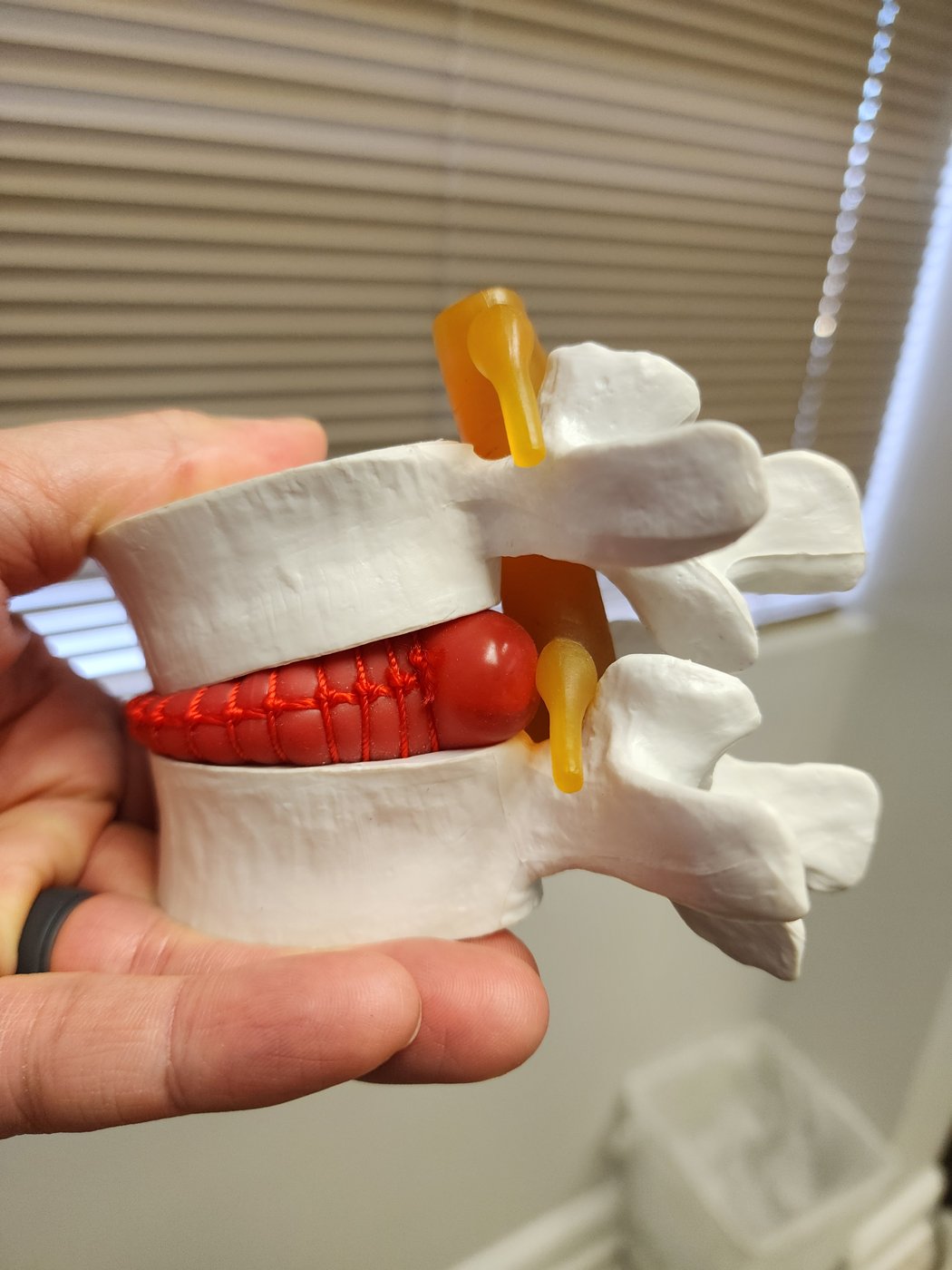
Sciatica is a symptom, not a diagnosis, and the useful question is always what is compressing the nerve. Most often it is one of the lumbar disc injuries: a bulge or a herniation at L4-L5 or L5-S1 crowding the root as it exits. It can also come from narrowing of the channel the nerve travels through, from degenerative changes that have collapsed disc height, from a facet joint that has locked and swollen, or from a sacroiliac joint that is no longer moving correctly. Muscle involvement, such as a piriformis gripping the nerve behind the hip, is real but is more often a consequence of the spinal problem than the origin of it.
Each of those sources responds to something different. That is exactly why care that treats every leg pain the same way tends to fail, and why so many of our patients arrive here having already tried it.
How we relieve it
Once the examination identifies the level and the mechanism, treatment is built around taking pressure off that specific structure and keeping it off.
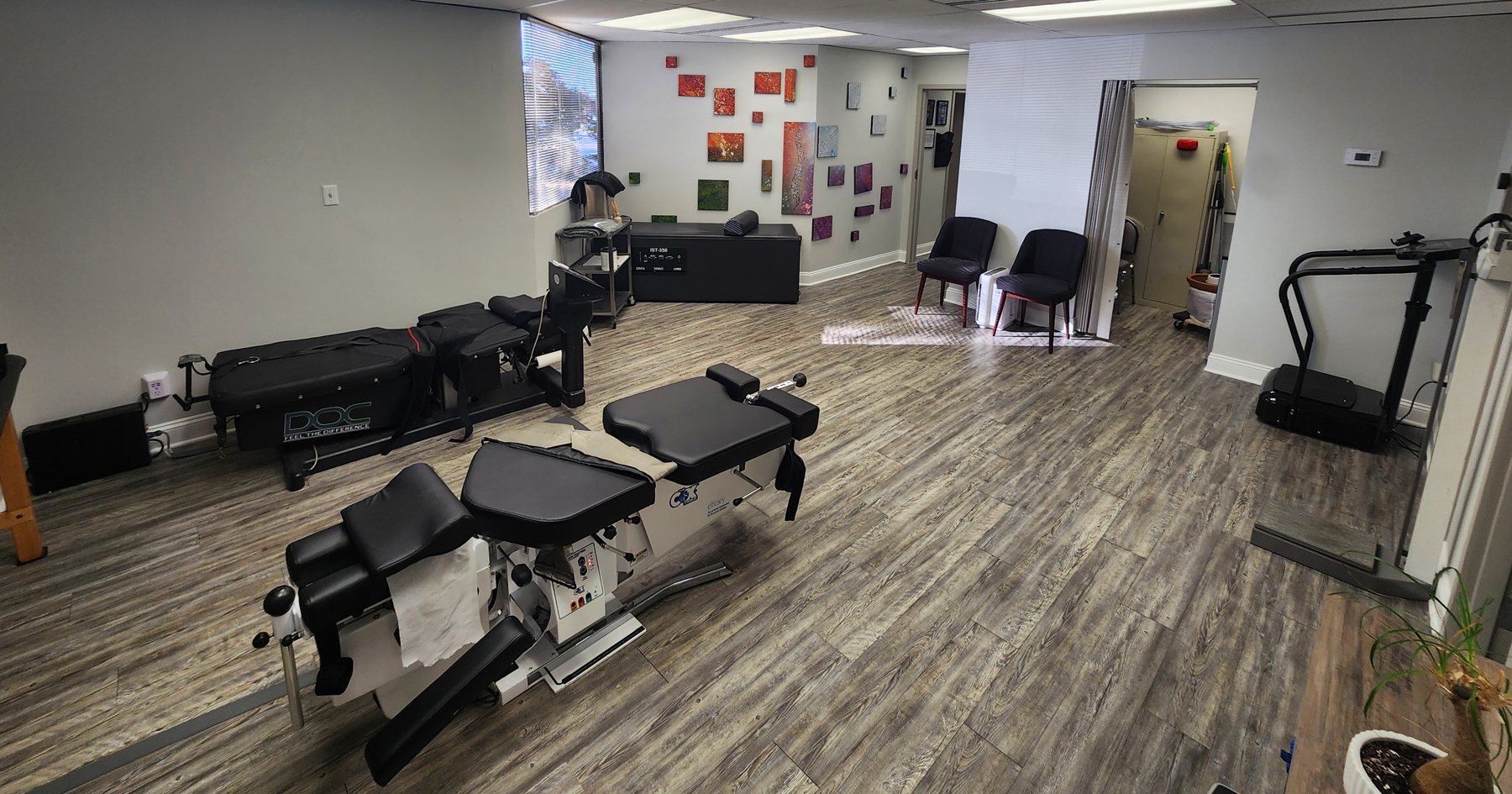
- Decompression. The motorized DOC table delivers spinal decompression programmed to the injured level, creating negative pressure inside the disc so bulging material can draw back toward center and fluid can move in. For cases that call for a gentler, doctor-guided pull, the Cox 8 table provides hands-on Cox flexion distraction. The handheld VDP (Vertebral Distraction Pump) is FDA registered and creates 2 to 3 mm of segment-specific distraction of the facet joints and disc, anywhere from C2 to the sacrum, which is useful when one joint is the problem rather than a whole region.
- Specific adjusting. Restoring motion to the joints above and below the irritated root stops them from overloading it. PulStar computer-guided adjusting maps the spine with real-time analysis before and after, so the correction is measured rather than guessed. Impulse and Activator instruments handle segments that need a light touch. None of it involves twisting or cracking.
- Nerve support. The hako-med PRO ElecDT HT delivers horizontal therapy electroanalgesia, and Neuragene electroanalgesic delivery supports irritated peripheral nerves. For acute pain and the muscle spasm that guards around it, interferential stimulation calms things enough for the structural work to hold.
- Tissue repair. Class IV cold laser is FDA cleared photobiomodulation that accelerates tissue repair and calms inflammation around the nerve root, where much of the pain is chemical rather than purely mechanical.
Supportive care fills in around all of it. Intersegmental traction on the roller table, therapeutic ultrasound, and shortwave diathermy warm and mobilize the low back so the adjustment holds between visits.
Some leg pain is not sciatica. Hip joint disease, vascular problems, and peripheral neuropathy can all imitate it, and each one needs something we may not be the right people to give. The sixty minute examination is there to make that call honestly before you spend a dollar on treatment.
What your first visit looks like
Your new patient examination runs a full sixty minutes. Dr. Hayes takes a real history, then performs neurological, physical, and orthopedic testing: reflexes, muscle strength, sensation mapping, and the specific orthopedic tests that separate a nerve root problem from a joint or muscle problem. He reviews any imaging you bring, and you receive your first adjustment the same visit. Nothing is rushed and no stone is left unturned.
Most people who come to us have already sat through ten minute appointments that ended in a prescription or a shrug. We do the opposite. You leave knowing what is compressing the nerve, why the pain shows up where it does, and what a plan to relieve it actually requires. Dr. Hayes trained under Dr. Patrick Montgomery and was recognized in 2024 as a top US specialist for spinal decompression and neuropathy. Bonesetters is by appointment only, and we see patients from Chesterfield, Ballwin, Creve Coeur, Ladue, Town and Country, and Des Peres.
Questions, answered
Is sciatica a diagnosis or a symptom?
It is a symptom. Sciatica describes pain traveling along the path of the sciatic nerve, but it does not say what is compressing or irritating that nerve. A lumbar disc, a narrowed nerve channel, a locked sacroiliac joint, and a tight piriformis muscle can all produce leg pain that a patient calls sciatica. The examination exists to identify which one you actually have, because the treatment is different for each.
Why does my leg hurt when my back feels fine?
The nerve is irritated at its root in the low back, but the brain interprets the signal as coming from wherever that nerve normally reports: the buttock, the thigh, the calf, the foot. Plenty of patients have significant leg pain with almost no back pain at all. The absence of back pain does not rule out a disc.
Will an adjustment make sciatica worse?
Not when the source has been identified first. Adjusting a lumbar spine without knowing which level and which direction the disc has moved is how people get worse. Dr. Hayes tests before he treats, and much of the work here is done with low-force instruments such as PulStar, Impulse, and Activator, which involve no twisting and no cracking.
How long does sciatica take to settle down?
It depends on what is causing it, how severe the nerve compression is, and how long you have had it. Nerve pain that started last week behaves very differently from leg pain someone has carried for two years. After the examination, Dr. Hayes lays out a specific plan with a defined number of visits, so you know the scope and the cost before you commit to anything.
I have already had injections. Is it too late for this?
No. Many of our patients arrive after injections wore off or after a surgical consult left them looking for another option. Prior treatment does not disqualify you. If the examination shows that this care is not right for your case, Dr. Hayes will tell you plainly and point you where you should go.
Find out what is pinching the nerve.
One thorough examination answers it. Book online or call the office and we will take a proper look.