
Knee pain treatment in Chesterfield, MO
Non-surgical care for arthritic, torn, and overused knees, aimed at the tissue that hurts and the hip mechanics that keep hurting it.
A knee that aches on stairs, swells the day after yard work, stiffens up in a chair, or catches and gives way is reporting a load problem. Sometimes the source is inside the joint: cartilage that has thinned, a meniscus that has degenerated or torn, a tendon that has been irritated for months. Just as often the source is above it. Knees are followers. They go where the hip and the foot send them, and they absorb whatever the pelvis fails to absorb.
Most patients reach us after the usual sequence has run out: rest, anti-inflammatories, an injection that helped for a while, a round of therapy, and then a conversation about arthroscopy or replacement. We are not against surgery. We are against having it before conservative care has had a genuine attempt, because the mechanics that wore the knee down do not change on an operating table. If those mechanics are still there afterward, the new joint inherits them.
Why the hip and your gait matter
The knee is a hinge caught between two joints that rotate. When the pelvis is torqued or a sacroiliac joint has stopped moving well, one leg starts functioning as though it were shorter, and the knee on that side absorbs the difference stride after stride. A hip that will not rotate internally forces the tibia to rotate instead. A foot that pronates hard collapses the arch and drives the knee inward on every step, loading the inside compartment, which is exactly where knee arthritis usually shows up first.
That is why our examination does not stop at the painful joint. Dr. Hayes assesses hip range of motion, pelvic alignment, sacroiliac movement, and how you actually walk. Treating only the knee in a body that keeps mis-loading it means treating the place the pain landed rather than the place that produced it.
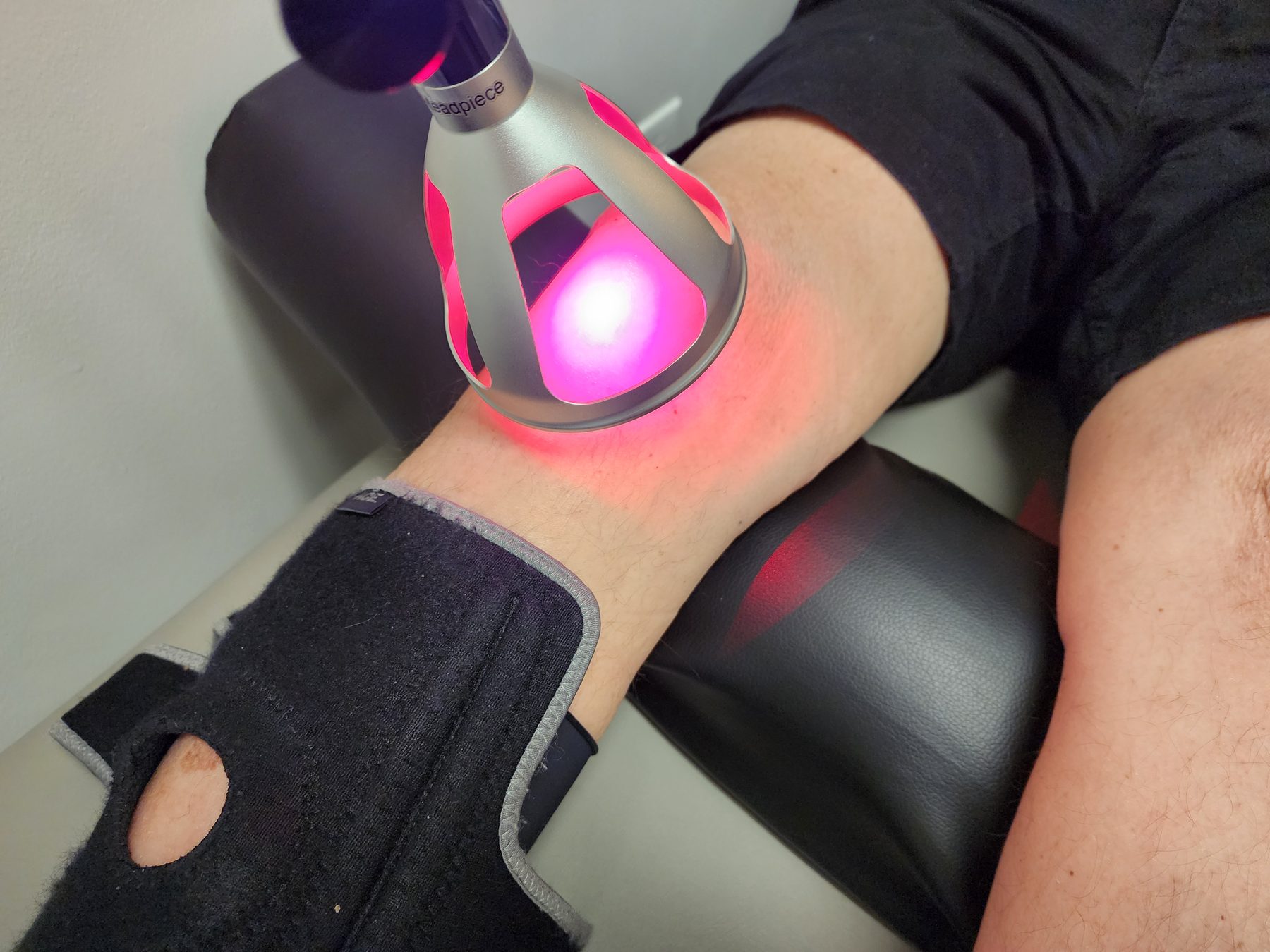
Where cold laser and shockwave fit
Class IV cold laser is photobiomodulation, and it is FDA cleared. Light at a specific wavelength and dose is absorbed by the tissue, which raises cellular energy production, calms inflammatory signaling, and improves local circulation. On a knee that means the joint capsule, the surrounding tendon, and the soft tissue around the kneecap get a metabolic push toward repair. It is painless, most patients feel mild warmth, and there is no downtime afterward.
Our Storz shockwave therapy does a different job. Radial acoustic waves are driven into tissue that has stalled out and stopped healing on its own: chronic patellar tendinopathy, pes anserine irritation, IT band insertion pain, thickened scar tissue around an old injury. The mechanical stimulus restarts a repair response in tissue that had settled into a chronic, unproductive state.
Which of the two you receive, or whether you receive both, is decided by the examination findings rather than by a package. Swollen, degenerative, arthritic knees generally do better with laser. Sharply localized tendon pain that has been present for months is shockwave territory. Both are priced per treatment, so you always see what you are paying for.
Knee problems we see
- Knee osteoarthritis and joint degeneration
- Meniscus injuries, including cases already pointed toward arthroscopy
- Patellar and quadriceps tendinopathy
- Patellofemoral pain and kneecap tracking problems
- IT band syndrome and pes anserine bursitis
- Overuse pain from running, cycling, standing work, or a sudden return to activity
- Post-surgical knees that never fully came back
Honest candidacy, always. Some knees belong to a surgeon. A joint that locks and will not straighten, a torn ligament leaving the knee unstable, or end-stage degeneration is a surgical problem, and Dr. Hayes will tell you that at the examination rather than sell you a plan. The exam exists to find out which kind of knee you have.
What care looks like here
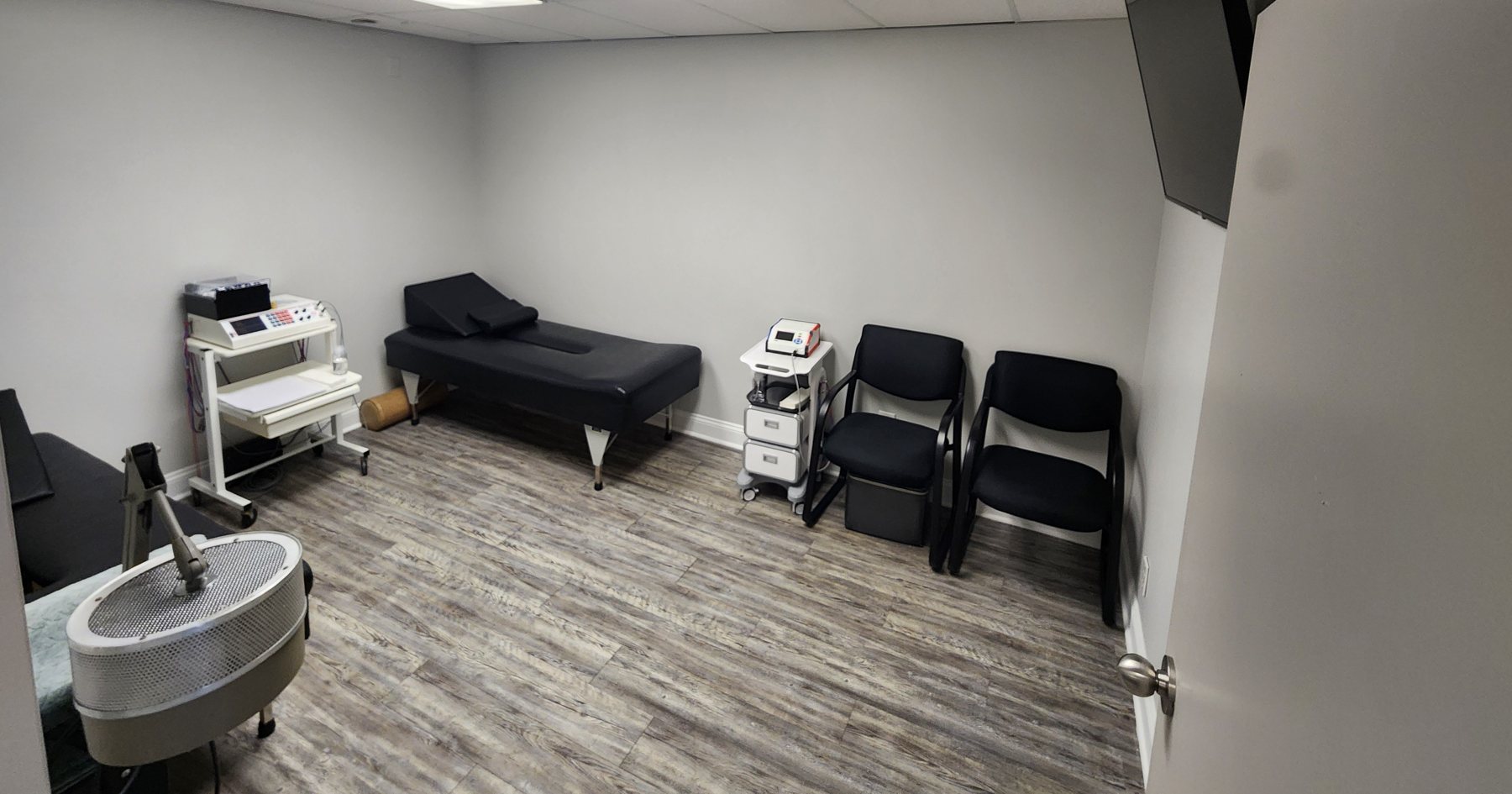
Your first visit is a sixty minute examination: history, neurological, physical, and orthopedic testing, an assessment of hip and pelvic motion, and your first adjustment. Nothing is rushed. From there, care pairs the modality your knee needs with specific adjusting to restore motion through the pelvis, hip, and lower extremity. When a joint is irritable, that adjusting is done with low-force instruments such as the PulStar, Impulse, or Activator, with no twisting and no cracking. Supportive tools including therapeutic ultrasound, shortwave diathermy, and intersegmental traction warm and prepare tissue so the correction holds, and stretch therapy with Yevgeniy Kapusterynsky is available when tight hips and hamstrings are part of the picture.
Questions, answered
Can chiropractic care actually do anything for a knee?
Yes, when the knee problem has a mechanical driver, which most of them do. We treat the knee directly with laser or shockwave, and we correct the hip, pelvic, and foot mechanics that keep loading it. Knees that only ever get treated at the knee tend to come back.
Will this let me avoid a knee replacement?
We cannot promise that, and anyone who does is guessing. What we can tell you after the examination is whether your knee has a mechanical and inflammatory problem worth treating conservatively first, or whether the degeneration is far enough along that a surgical consult is the honest answer.
Does shockwave therapy hurt?
It is intense but brief. Most patients describe a firm, rapid tapping over the treated spot, strongest in the first minute. Intensity is dialed to what you can tolerate and adjusted in the moment. Cold laser, by contrast, feels like mild warmth or nothing at all.
My MRI shows a meniscus tear. Is conservative care still worth trying?
Often, yes. Many meniscus findings on imaging are degenerative rather than acutely torn, and they are common in knees that do not hurt at all. A locked knee that will not straighten is a surgical problem. A painful, swollen, stiff knee with a meniscus finding frequently responds to load correction and tissue-level treatment.
How many visits will this take?
It depends on the tissue involved and how long it has been irritated. Tendon problems treated with shockwave usually run a short series. Arthritic knees are managed over a longer arc. Dr. Hayes gives you a specific plan and the cost of it after the examination, before you commit to anything.
Before you schedule the surgical consult, get a second opinion on the mechanics.
One examination tells you whether your knee has a problem worth treating conservatively. Book online or call the office.