
Herniated and bulging disc treatment in Chesterfield, MO
Disc injuries are what this practice is built around. We treat the disc itself, without injections and without surgery.
Between each pair of vertebrae sits a disc: a tough outer ring wrapped around a soft, gel-like center. It works as a shock absorber and a spacer, holding open the small channels where your spinal nerves exit. When that outer ring stretches and the disc pushes outward past its normal border, it is called a bulge. When the ring tears and inner material escapes through it, that is a herniation. Either one can crowd a nerve root mechanically or irritate it chemically, and either one can produce the same miserable set of symptoms.
What a disc injury actually feels like
Pain in the back or neck is often the least useful clue. What tells us a disc is involved is the pattern: pain that travels down an arm or a leg, numbness or pins and needles in a specific band of skin, weakness in a grip or a foot, and symptoms that change sharply with position. Sitting, bending forward, coughing, or sneezing usually makes a lumbar disc worse. Many patients cannot find a comfortable way to sleep. Some have no back pain at all, only the leg.
Those position-dependent details matter clinically, because they tell Dr. Hayes which level is involved and which direction the disc material has moved. That is the difference between treating a region and treating an injury.
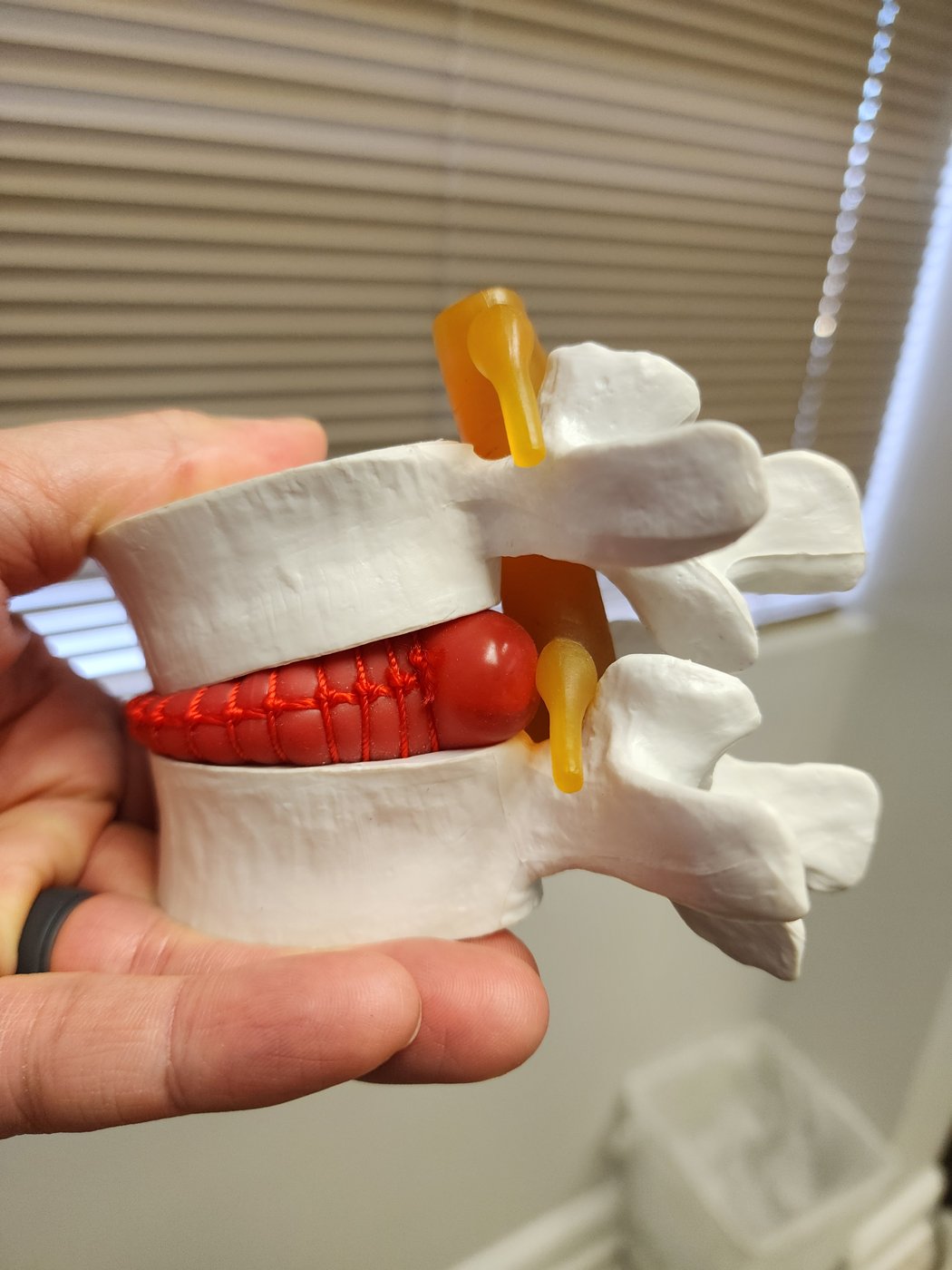
Why discs are slow to heal on their own
A disc has almost no direct blood supply. It feeds by imbibition: pressure changes during movement pump fluid and nutrients in and waste out. An injured, compressed disc loses that pumping action right when it needs it most, and the pressure that caused the injury never lets up. Rest does not restore it, and pain medication does nothing to the mechanics. To heal, a disc needs pressure taken off it long enough and often enough for that exchange to restart.
The Disc Care Protocol
Our research-based protocol addresses the disc from several directions at once, because a single tool rarely resolves a real disc injury.
- Decompression. The DOC table delivers motorized cervical and lumbar spinal decompression, programmed to the specific level of your injury. The Cox 8 table gives Dr. Hayes hands-on Cox flexion distraction for cases that call for a gentler, doctor-guided pull. The handheld VDP (Vertebral Distraction Pump) is FDA registered and creates 2 to 3 mm of segment-specific distraction of the facet joints and disc anywhere from C2 to the sacrum.
- Class IV cold laser. FDA-cleared photobiomodulation that accelerates tissue repair and calms inflammation in the irritated tissue around the disc and nerve root. Read more about cold laser.
- HakoMed electroanalgesia. The hako-med PRO ElecDT HT delivers horizontal therapy for radiating nerve pain and peripheral nerve support, which is often the symptom patients want handled first.
- PulStar adjusting. Computer-guided multi-impulse percussion adjusting with real-time Star analysis, so the joints above and below the injured disc move correctly and stop overloading it. No twisting, no cracking.
Supportive care fills in around those four: intersegmental traction, therapeutic ultrasound, and shortwave diathermy warm and mobilize tissue so the work holds between visits.
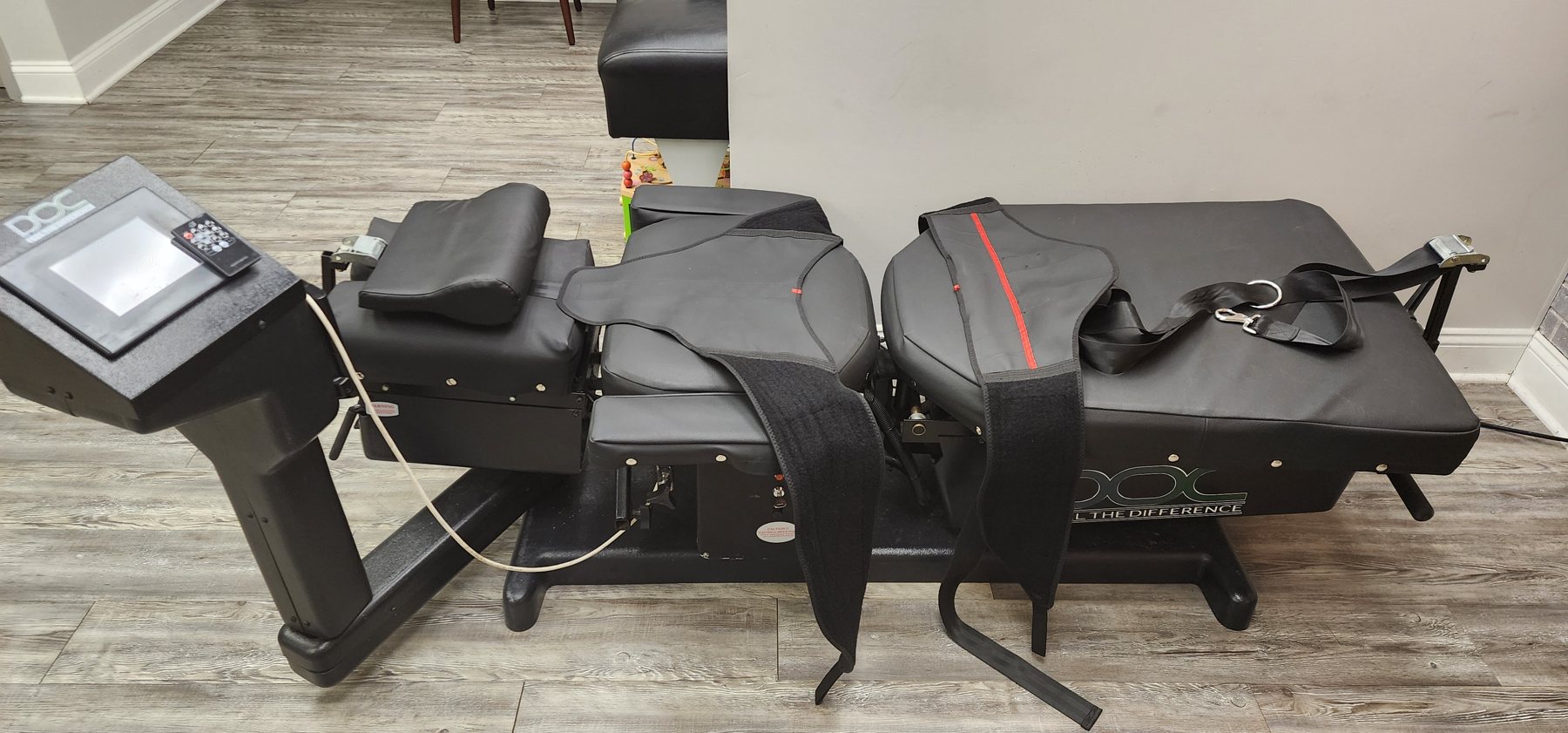
Honest candidacy, always. This care is powerful for the right disc problem and wrong for some others. The sixty minute examination exists to make that call before you spend a dollar on treatment, and Dr. Hayes will tell you plainly if your case belongs somewhere else.
What your first visit looks like
Your new patient examination runs a full sixty minutes: a real history, then neurological, physical, and orthopedic testing, a review of any imaging you bring, and your first adjustment. Nothing is rushed, and no stone is left unturned. Most patients who come to us have already been through short appointments that ended in a prescription or a shrug, so we do the opposite. You leave knowing which disc is involved, why it is behaving the way it is, and what a plan to fix it actually requires.
Dr. Hayes trained under Dr. Patrick Montgomery and was recognized in 2024 as a top US specialist for spinal decompression and neuropathy. Bonesetters is by appointment only, and we see patients from Chesterfield, Ballwin, Creve Coeur, Ladue, Town and Country, and Des Peres.
Questions, answered
What is the difference between a bulging disc and a herniated disc?
A bulging disc is a disc whose outer wall has stretched and pushed outward while still holding together. A herniation means that outer wall has torn and inner disc material has pushed through the opening. Both can press or chemically irritate a nearby nerve root, which is why the symptoms often feel identical from the outside.
Do I need an MRI before you will treat me?
Not always. The examination, including neurological and orthopedic testing, tells Dr. Hayes a great deal about which level is involved and how the nerve is behaving. If imaging is needed to confirm the diagnosis or rule out something that changes the plan, he will tell you that during your first visit and help you get it.
Can a disc actually heal, or am I just managing pain?
Discs are living tissue with a limited blood supply, so they repair slowly and only when pressure comes off long enough for fluid and nutrients to move back in. That is the entire mechanical purpose of the protocol. The goal is structural change in the disc, not masking the pain while the injury stays the same.
What if I have already had injections, or a surgeon has recommended surgery?
Many of our disc patients arrive in exactly that position. Prior injections do not disqualify you, and a surgical recommendation is worth a second opinion from someone whose tools are non-surgical. The examination determines candidacy honestly. If we do not believe this care can help your case, we will say so.
How long does disc care take?
It depends on which disc, how severe the injury is, and how long you have had it. After the examination and imaging review, Dr. Hayes lays out a specific plan with a defined number of visits, so you know the scope and the cost before you commit to anything.
Find out what your disc really needs.
One thorough examination answers it. Book online or call the office and we will take a proper look.