
Computer-guided adjustments in Chesterfield, MO
PulStar, Impulse, and Activator instrument adjusting with live spinal analysis. Precise, measured corrections with no twisting and no cracking, for every age.
An adjustment exists to restore motion to a joint that has stopped moving the way it should. Computer-guided instrument adjusting accomplishes that without twisting your neck, without bending your back over a table, and without the pop most people picture when they hear the word chiropractor. A handheld instrument delivers a fast, shallow, precisely measured impulse into the one segment that needs it. The computer identifies that segment before we begin, and shows what changed after we finish.
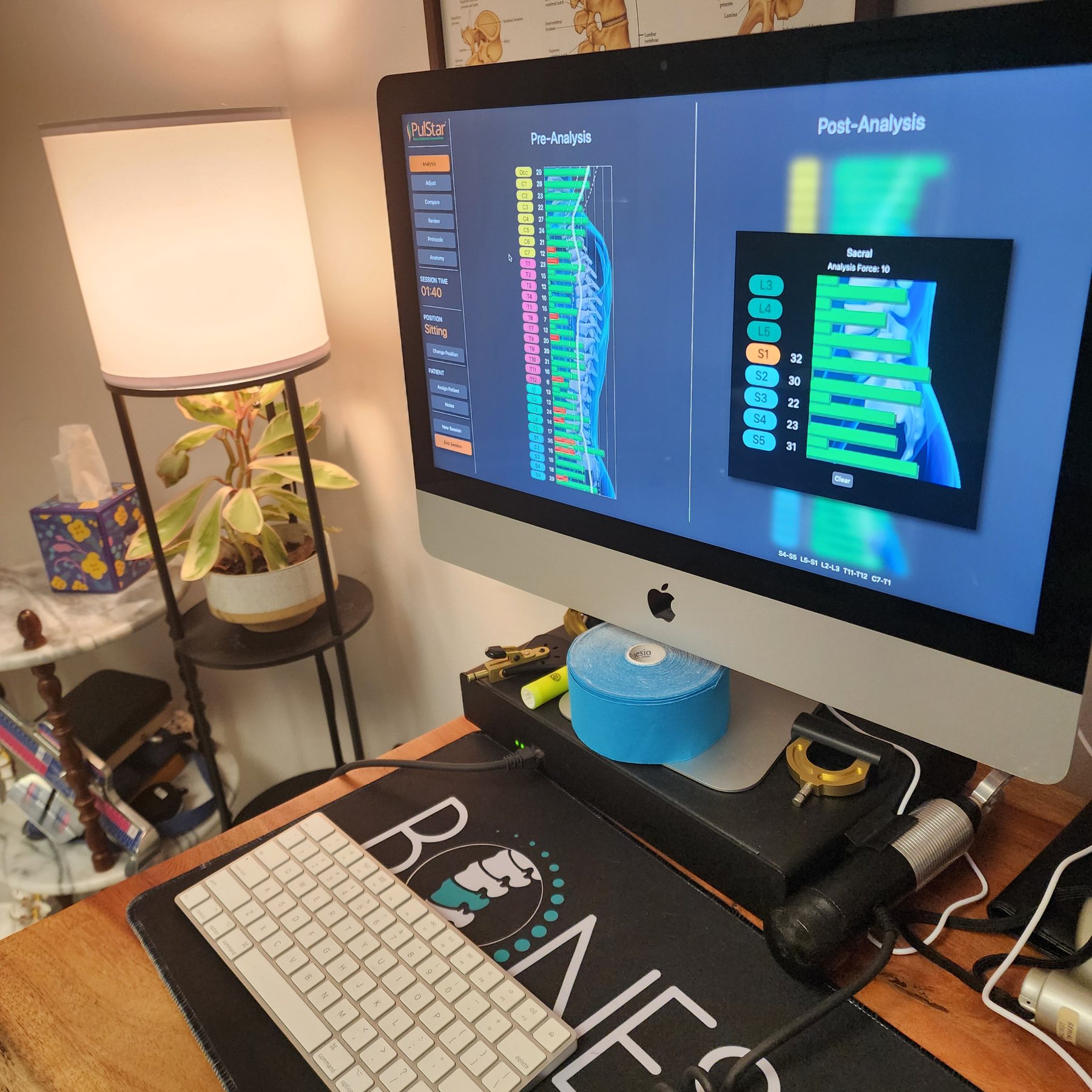
The computer reads your spine, then reads it again
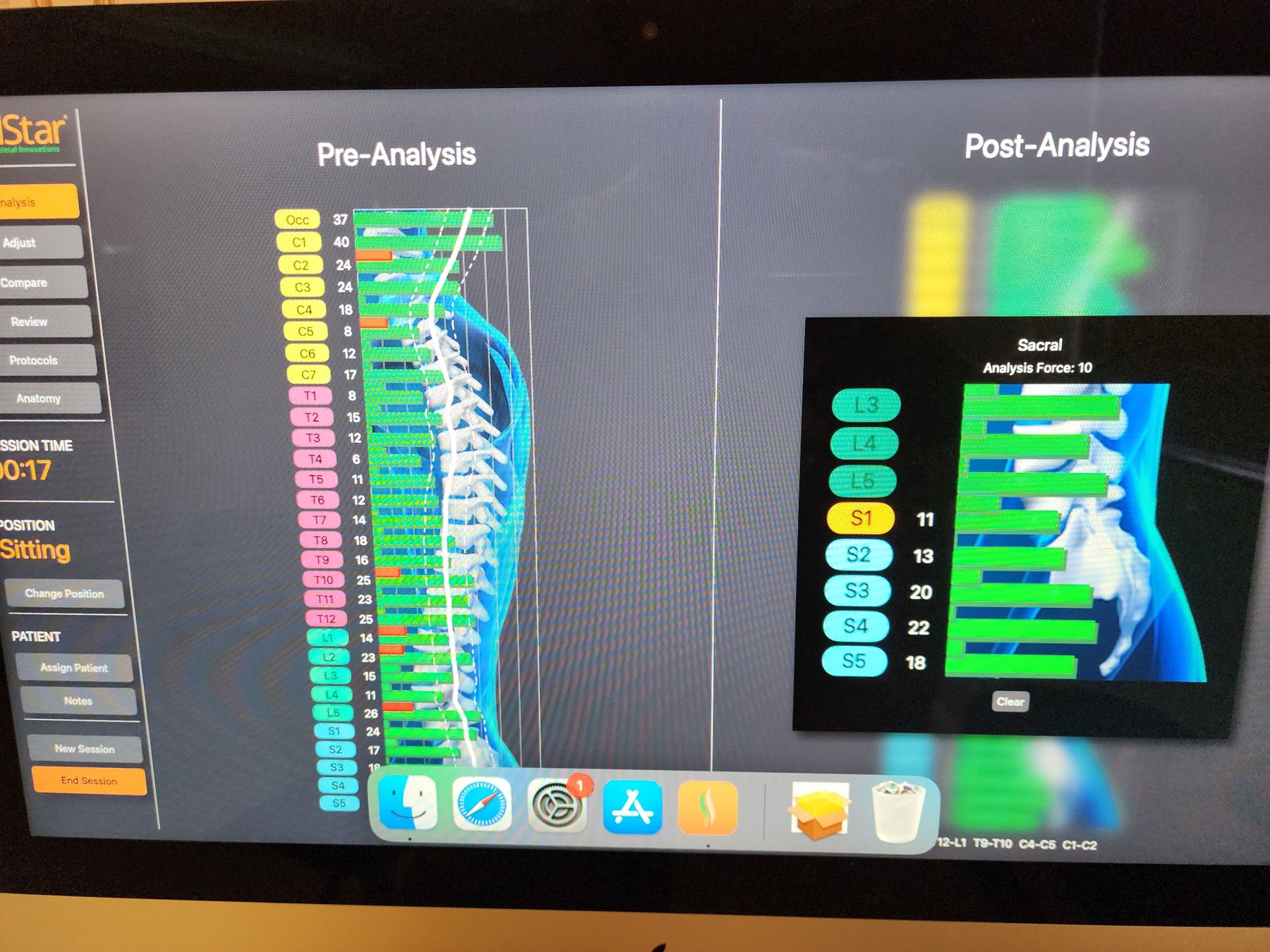
Before any correction is made, the PulStar head is walked down your spine one vertebra at a time. At each level it sends a light test impulse and records how firmly that segment resists it, and how much of that force spreads into the vertebrae on either side. A segment that is moving normally absorbs and shares the force. A segment that is locked, guarded, or fixated pushes back hard and refuses to share it. The software plots every level as a bar on a graph, so a restriction that you feel only as a vague ache in one area shows up as a specific pattern at a specific height in your spine.
That readout drives the treatment. Dr. Hayes adjusts the levels the analysis flagged, then runs the identical scan again. The pre and post graphs sit side by side on the screen. You see which bars came down, and you see it in the same visit, measured rather than described. It is objective feedback on a treatment that is usually judged by feel alone.
Three instruments, one principle
The PulStar works by multi-impulse percussion. Rather than one large thrust, it delivers a rapid train of small impulses at a frequency that persuades guarded muscle to release instead of bracing against the correction. The Impulse is a handheld adjusting instrument used for quick, specific work at a single joint. The Activator Method uses a low-force handheld instrument and remains one of the gentlest approaches in chiropractic.
All three share the same principle: the smallest amount of force that will do the job, delivered exactly where it belongs, in a direction and at a depth that are controlled by the instrument rather than by how a doctor happens to be standing that day. Repeatability is the point. The correction you get on your fourth visit is the same correction you got on your first.
Who it helps
- Patients with neck pain who do not want their neck rotated or twisted
- Chronic and acute back pain, including cases too irritable for manual adjusting at first
- Older patients, and patients with osteoporosis, arthritis, or previous spinal surgery
- Children and infants, where the force is scaled down accordingly
- Anyone whose muscles guard so strongly that a manual adjustment will not hold
- Patients who simply prefer to know what is being measured and why
Gentle is not the same as passive. Low force does not mean low effect. It means the force is aimed well enough that a large one is unnecessary, which is precisely what the analysis is for.
What a visit looks like
You stay clothed and either sit forward or lie face down while the analysis runs. It takes a few minutes and is completely painless. Dr. Hayes reviews the graph with you, explains which levels are restricted and how that relates to what brought you in, then treats those levels. The adjustment itself is quick, and the instrument does the work while you stay relaxed. Then the second scan runs and you compare the two.
Computer-guided adjusting is rarely used alone here. Supportive work such as intersegmental traction, therapeutic ultrasound, or shortwave diathermy is often used first to warm and mobilize tissue so the correction holds longer. Visits are unhurried by design. Nothing is rushed and no stone is left unturned.
See a PulStar adjustment
No twisting, no cracking, nothing forceful. Here is what a computer-guided adjustment actually looks like in the office.
Questions, answered
Does a computer-guided adjustment hurt?
No. The instrument delivers a series of very fast, very shallow taps. There is no twisting, no bending, and no forceful thrust. Most patients describe it as a light knocking sensation and are surprised by how little they feel.
Will I hear a pop or a crack?
Almost never. The popping sound in a manual adjustment comes from gas releasing inside a joint as it is stretched open. Instrument adjusting restores motion without that stretch, so the sound is usually absent. The absence of a pop does not mean nothing happened, and the post-treatment analysis shows you exactly what did.
What is the Star analysis actually measuring?
It measures how stiff each spinal segment is. The instrument sends a light test impulse into the vertebra and records how much that segment resists and how the resistance travels into the segments beside it. Stiff, restricted levels read differently than levels moving normally, and the software graphs the whole spine so the pattern is visible.
Is instrument adjusting safe for children and older adults?
Yes, and it is often the preferred method for both. The force is low, measured, and adjustable, which makes it appropriate for small children, for patients with osteoporosis or arthritis, for post-surgical spines, and for anyone who does not want to be twisted.
Is this instead of manual adjusting, or in addition to it?
It depends on your spine. Dr. Hayes uses manual and instrument methods, and the examination decides which one your case calls for. Many patients receive a combination, and some receive instrument work exclusively.
See your spine measured, not guessed at.
One examination shows you where the restrictions are and what it takes to release them. Book online or call the office.