Storz shockwave therapy in Chesterfield, MO
Radial acoustic waves that break up scar tissue and restart healing in tendon, joint, and soft-tissue injuries that have stopped responding to everything else. Non-invasive and drug free.
Some injuries do not heal, they stall. A tendon or a soft-tissue injury that has been there for months is no longer inflamed in the way a fresh injury is. The body has quietly stopped treating it as a problem to repair, laying down disorganized scar tissue instead and letting blood supply to the area fall off. That is why rest, stretching, and anti-inflammatories often go nowhere: there is nothing left to calm down, and nothing telling the tissue to rebuild.
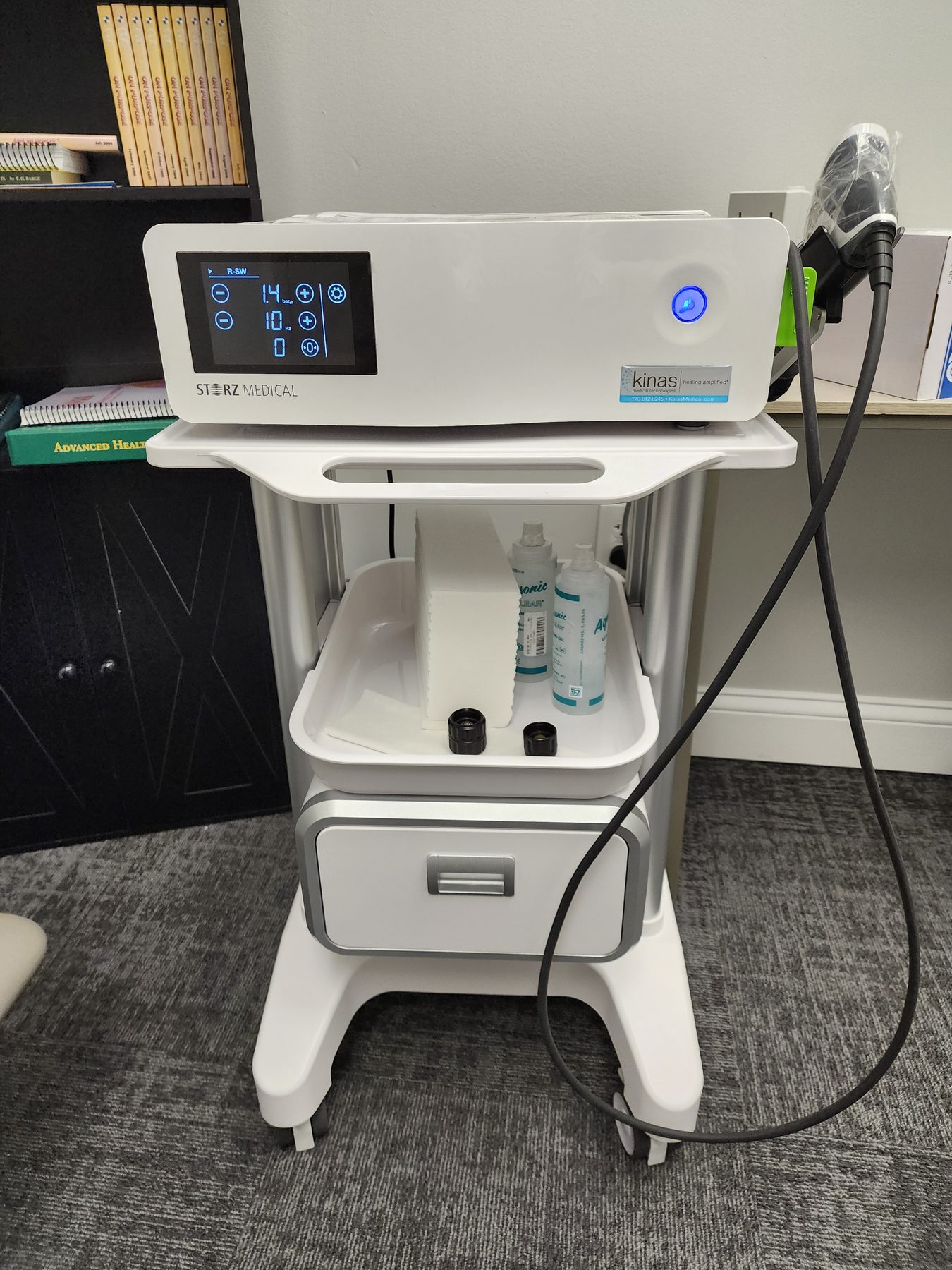
Shockwave therapy makes the body notice again. The Storz unit delivers rapid radial acoustic pressure waves through the skin into the injured tissue. Mechanically, those waves break up adhesions and fibrotic scar tissue that have locked the area down. Biologically, the controlled stress signals the body to increase circulation to a region it had written off, and to restart the repair sequence that stalled out. It is a reset, not a painkiller.
What radial shockwave actually is
The name is misleading in one respect: there is no electricity involved and nothing is shocking you. A shockwave is an acoustic pressure wave, the same class of energy used to break up kidney stones, delivered here at therapeutic intensity through a handheld applicator. Radial means the wave spreads outward as it enters the tissue, covering a broader treatment field rather than focusing to a single deep point. That makes it well suited to tendons, muscle attachments, and the flat sheets of fascia where chronic soft-tissue problems live.
Dr. Hayes controls three things at the applicator: intensity, frequency, and how long the head stays over a given spot. Dense, long-standing scar tissue takes a different setting than an irritable tendon that is still reactive. That is a clinical judgment made at the table, not a preset button, and it is one reason treatment here is not rushed.
Who it helps
Shockwave earns its place with the cases that have already failed something else. It is most useful for:
- Plantar fasciitis and stubborn heel pain
- Tennis elbow, golfer's elbow, and other chronic tendinopathies
- Rotator cuff and shoulder pain that has not responded to rest or therapy
- Achilles tendon problems
- Hip, glute, and IT band attachment pain
- Chronic knee pain involving the patellar tendon or surrounding soft tissue
- Scar tissue and adhesions from an old injury or surgery
- Trigger points and muscle tissue that will not release with manual work
It is also frequently part of the plan for patients whose chronic pain has a significant soft-tissue component, where the joints have been addressed but the surrounding tissue never recovered its normal quality.
Shockwave is a tool, not a plan. It is used here when the examination shows a soft-tissue problem that has genuinely stalled. If your pain is coming from a disc, a nerve, or a joint that needs to move properly first, we will treat that instead and tell you so plainly.
How it fits with the rest of your care
Shockwave rarely works alone in this office, because a stalled tendon usually has company. Class IV cold laser calms the inflammation that follows treatment and accelerates tissue repair at the cellular level. Gentle instrument adjusting with PulStar, Impulse, or the Activator restores normal motion to the joint the injured tissue crosses, so the tissue is not being reloaded incorrectly every day. Where a joint is stiff or guarded, supportive therapies like intersegmental traction, therapeutic ultrasound, or shortwave diathermy warm and mobilize the area first so the shockwave reaches tissue that is ready to respond.
That sequencing matters. Breaking up scar tissue in a shoulder that still cannot rotate correctly buys you a few good weeks and then the tissue reorganizes exactly the same way. Fixing the mechanics and the tissue together is what makes the result hold.
What a session looks like
You sit or lie with the treatment area exposed. Dr. Hayes applies gel, then works the applicator over the injured tissue while it delivers pulses, moving deliberately across the area and pausing on the spots that reproduce your symptoms. Those tender spots are diagnostic: the tissue that responds loudest is usually the tissue that needs the work. Actual treatment time on the area is short, generally a few minutes per region, inside a longer visit that includes the rest of your care.
Afterward you may feel warm, mildly sore, or briefly more aware of the area. That is expected and typically settles within a day. There is no downtime, no medication, and nothing to recover from. Most patients go straight back to their day and are asked to keep moving normally rather than babying the area, because the point of the treatment is to get the tissue loading and rebuilding again.
Questions, answered
Does shockwave therapy hurt?
You feel a rapid tapping and a deep ache over the treated area, strongest directly on the injured tissue. Intensity is adjustable and Dr. Hayes works within your tolerance. Most patients describe it as uncomfortable but manageable, and it stops the moment the applicator lifts.
How many sessions will I need?
Stubborn tendon and soft-tissue cases typically need a short series of weekly sessions rather than a single visit. The exact number depends on how long the problem has been there and how the tissue responds. Dr. Hayes gives you a defined plan after the examination so you know the scope before you commit.
What is the difference between shockwave and cold laser?
They do different jobs. Class IV cold laser is photobiomodulation: light energy that calms inflammation and speeds cellular repair. Shockwave is mechanical: acoustic pressure waves that physically break up scar tissue and adhesions. Cases with dense fibrotic tissue often get both, laser to quiet the area and shockwave to remodel it.
How soon will I feel something?
Many patients notice a change in the area within a day or two, and it is common to feel some soreness first as circulation and repair activity increase. Because shockwave works by restarting a healing process, the meaningful change usually builds across the series rather than arriving all at once.
Is shockwave included in the price of an adjustment?
No. The $65 adjustment covers routine wellness care. Clinical modalities including shockwave, cold laser, and HakoMed are priced per treatment, and you will be told the exact cost before any of them are used.
An injury that stopped healing is not a lost cause.
One examination tells us whether the tissue can be restarted. Book online or call the office.