Supportive therapies in Chesterfield, MO
Intersegmental traction, therapeutic ultrasound, and shortwave diathermy. The preparation work that makes an adjustment easier to deliver and harder to lose.
A spine that is cold, guarded, and stiff fights the adjustment. Muscles splint around the segment you are trying to move, the joint resists, and whatever correction you do get tends to slide back within a day or two. Supportive therapies solve that problem. They warm the tissue, increase local circulation, and coax stiff segments into motion before Dr. Hayes puts his hands or an instrument on you. None of these three is the treatment by itself. All three make the treatment work better.
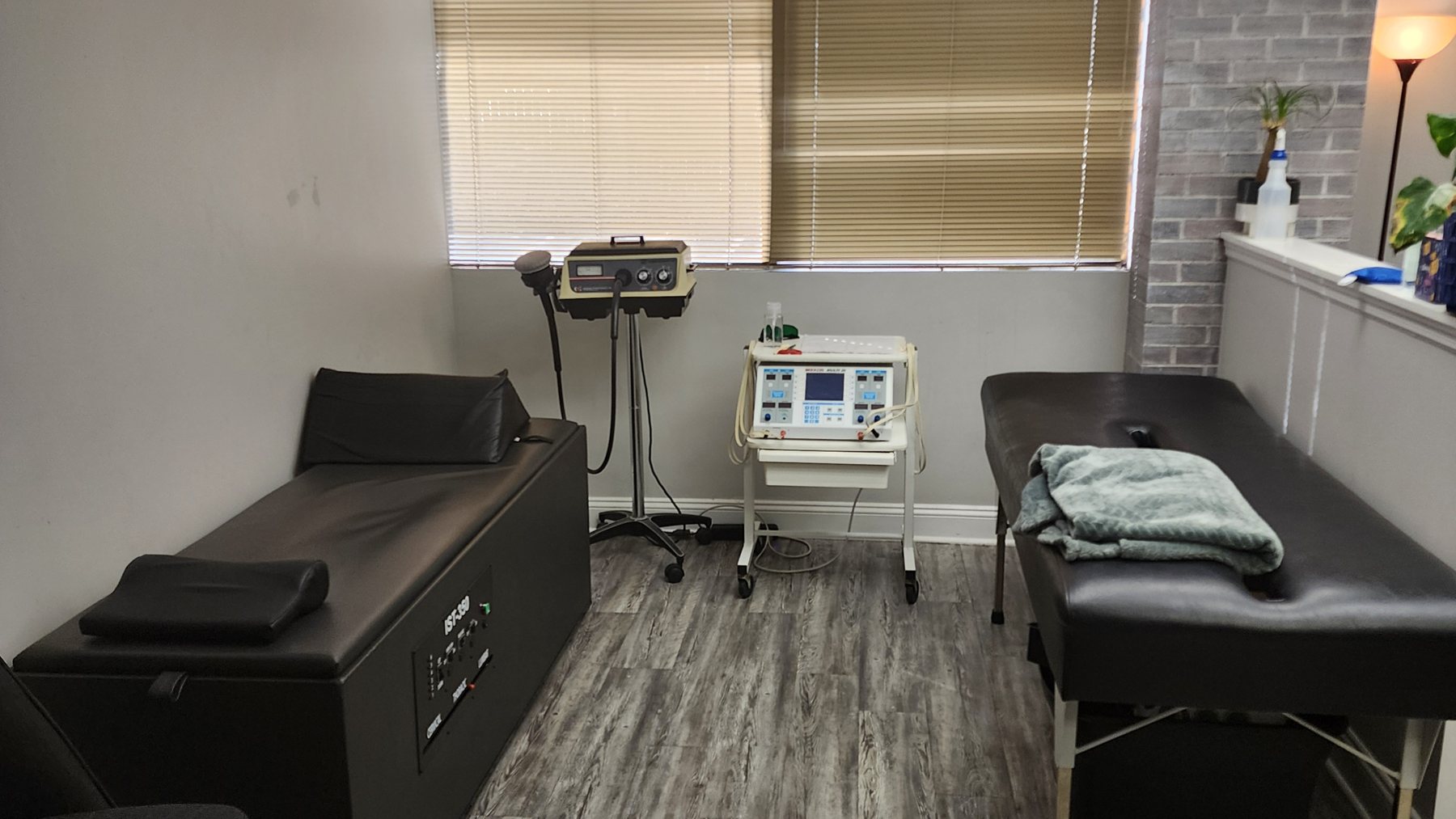
Intersegmental traction (the IST-350 roller table)
You lie face up on a padded table while a set of rollers travels slowly up and down the length of your spine, gently flexing each segment in turn. The point is motion. Spinal joints are lubricated and fed by movement, and segments that have been locked down for months rarely get any. Intersegmental traction restores that motion passively, without you having to do anything, which stretches the surrounding ligaments and muscles and reduces the guarding that would otherwise block an adjustment.
It is one of the most useful tools we have for chronic back pain and long-standing spinal stiffness, particularly in patients whose problem has been building for years rather than weeks. Roller height and speed are adjustable, so a fragile spine and an athletic one get very different settings.
Therapeutic ultrasound
Ultrasound uses high frequency sound waves, delivered through a handheld head and a coupling gel, to create deep vibration and gentle heat inside soft tissue. It reaches structures your hands cannot warm from the surface: deep muscle, tendon, ligament, and joint capsule. That deep warming increases blood flow to the area and makes fibrous, scarred tissue more pliable, which is why we often run it over a chronically tight shoulder, hip, or paraspinal region right before working on it.
Treatment lasts a matter of minutes and is applied directly over the target tissue. You will feel the head moving in slow circles and, depending on the settings, a mild warmth. Nothing else.
Shortwave diathermy
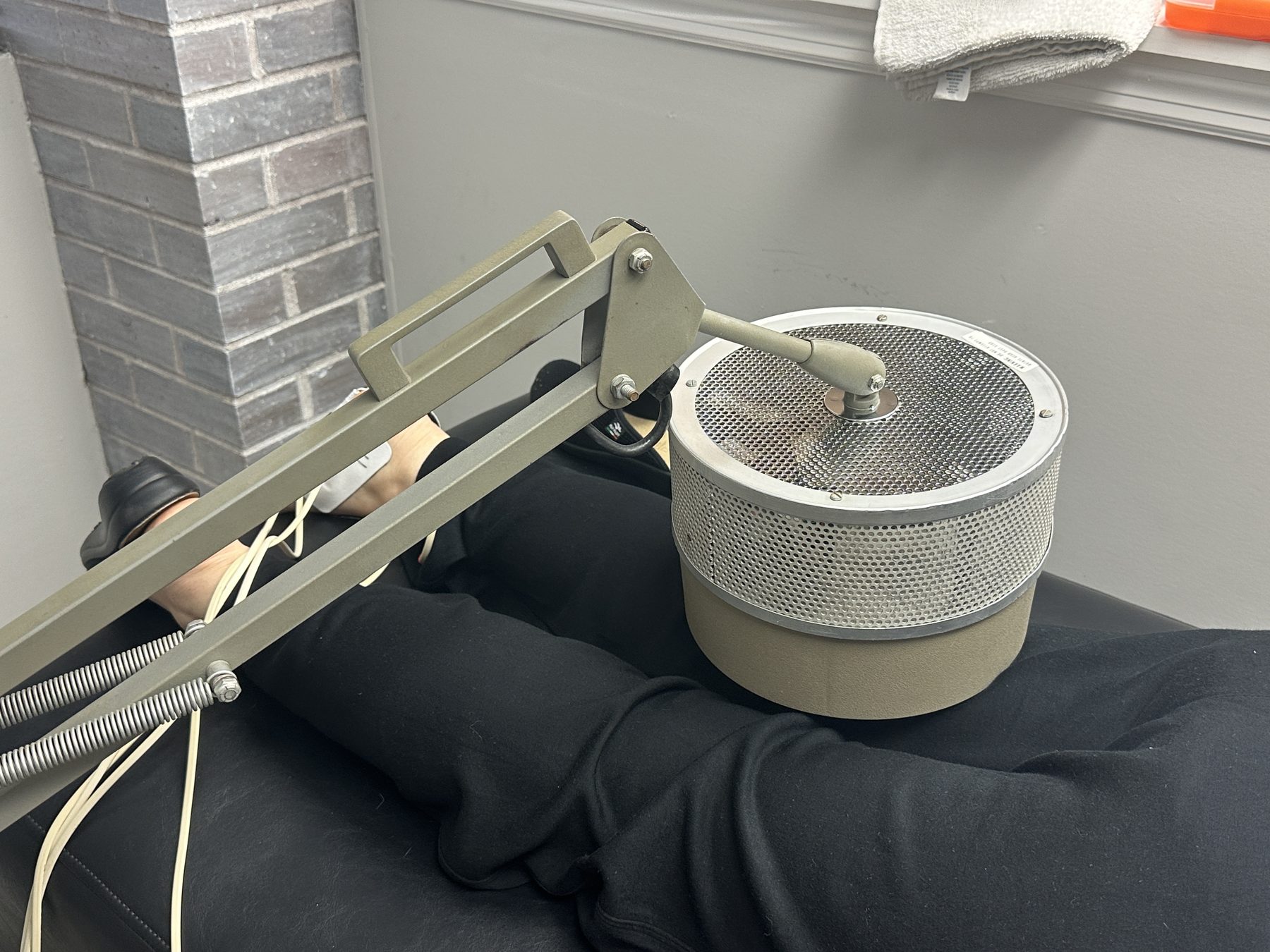
Diathermy delivers deep heat through electromagnetic energy rather than a surface heat pack. A hot pack warms your skin and the first few millimeters underneath it. Diathermy heats a broad region of muscle and joint tissue at depth, which is a meaningfully different effect: greater tissue extensibility, better circulation into a stubborn area, and a real reduction in the muscle spasm that surrounds an irritated segment.
We use it most often on large, thick, chronically tight regions such as the low back and the hips, and on cases of neck pain where the upper back and shoulders have been locked up long enough to hold the neck hostage. It is screened carefully. Deep heat is not appropriate for every patient or every body region, and that determination happens at your examination.
These are adjuncts, not a plan. If a clinic's whole treatment is heat and a roller table, you should ask why. Here they exist to serve the adjustment and the protocol. Dr. Hayes prescribes them by case, and if your spine does not need them, you will not be sold them.
Who these therapies help
- Chronically stiff spines that resist adjusting, or lose the correction quickly
- Muscle spasm and guarding around an irritated joint or disc
- Deep soft-tissue restriction: scarred, fibrotic, or long-immobile tissue
- Patients who need a gentler on-ramp before hands-on work
- Post-treatment soreness during an active disc or neuropathy protocol
What a visit looks like
Supportive therapies are layered into the front of a treatment visit. You might spend 8 to 15 minutes on the roller table while the tissue relaxes, then have ultrasound or diathermy applied to a specific problem region, then get adjusted. The whole sequence adds time to the appointment rather than replacing anything in it, which is part of why our visits are longer than the industry norm. Nothing is rushed and nothing is bundled in blindly. Note that the $65 adjustment visit covers routine wellness care; clinical modalities are priced per treatment, and you will know the cost before it is applied.
Questions, answered
Are these therapies a replacement for the adjustment?
No. They are preparation and support. Traction, ultrasound, and diathermy loosen and warm the tissue so the adjustment goes in more easily and stays in longer. The adjustment itself is still the treatment.
Does any of it hurt?
No. The roller table feels like a slow massage along the spine, ultrasound feels like nothing at all or a mild warmth, and diathermy feels like deep heat. Most patients find all three relaxing, and some fall asleep on the traction table.
How long do I spend on the roller table?
Usually 8 to 15 minutes before your adjustment. Dr. Hayes sets the time and roller height based on your spine, your tolerance, and what the day calls for.
Can I use these if I am already in a decompression protocol?
Often, yes. Supportive therapies are commonly layered into disc care and neuropathy care to prepare tissue and manage post-treatment soreness. Dr. Hayes decides the sequence so the therapies help each other rather than compete.
Is there anyone who should not have diathermy or ultrasound?
Yes. Deep heat and ultrasound are not appropriate over implanted electronic devices, certain metal implants, active malignancy, acute infection, or a pregnant abdomen, among other cases. Your examination screens for all of it before anything is applied.
Get the full picture first.
One sixty minute examination tells us what your spine actually needs. Book online or call the office.